


What is the greater Geneva Area ?
27-08-2026
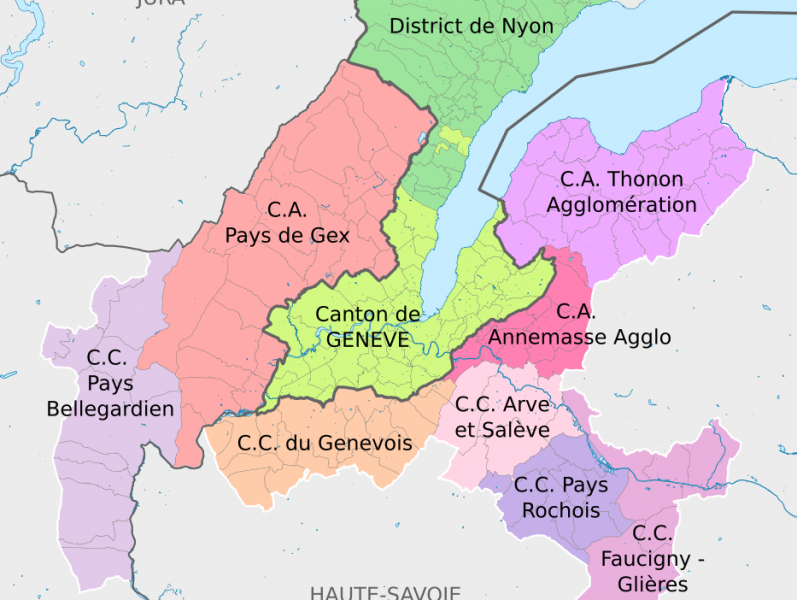
Par Flappiefh — Travail personnel, CC BY-SA 4.0
An orientation post for visitors who don't yet realize they're crossing a border every time they ride — covers what "Grand Genève" means and the practical quirks of cycling across it.
Definition
The Greater Geneva Area, also known as "Grand Genève" or the "Genevois," is a unique cross-border region.
Legally, it is an international community managing transportation, land use, and the environment for a territory of one million people. This collaboration facilitated the creation of the Léman Express (an international rail link), the extension of Geneva Public Transportation (TPG) into France, and the construction of a tramway line linking Annemasse to Geneva. It also includes the greenways, such as the ViaRhôna and the route to Chamonix.
In practice, the administration is complex. Various entities within the Greater Geneva Area collaborate across Swiss and French jurisdictions. A primary challenge is balancing urban development with the preservation of nature while navigating the differing laws of both countries.
Additionally, the region manages the daily flow of 120,000 French workers commuting into and out of Switzerland.
Cycling Map around the Greater Geneva Area
Why it matters when visiting:
While the Greater Geneva Area promotes integration, Switzerland, France, and the EU remain distinct institutional entities.
Little historic reminder:
- France and Switzerland are both part of the Schengen agreement, which allows people and goods to travel freely across borders.
- France is part of the European Union but Switzerland is not.
- France is part of the Euro zone but Switzerland is not.
Easy transborder transportation (tram, train, bus, boat)
Thanks to significant progress in regional transit, several options connect French cities (such as Annemasse, St-Julien-en-Genevois, Bellegarde, and Gex) with Swiss destinations (Geneva and Coppet):
- The Léman Express is centered on the CEVA line (Cornavin, Eaux-Vives, Annemasse). Trains run every 15 minutes during peak hours, linking Coppet to several French cities through central Geneva.
- Tramway 17 connects Annemasse to the Carouge district via central Geneva, with a frequency of 12 minutes during peak hours (link to TPG). Bicycles are permitted, transporting them is free on the French side, but a supplementary ticket is required in Switzerland. We recommend avoiding bike transport during rush hours.
- TPG buses provide frequent service to St-Julien-en-Genevois and Thonon-les-Bains. In Annemasse, TAC manages connections, while Star’t serves Thonon. These networks are integrated to ensure smooth travel. The TPG website provides information for all nearby networks.
- For further destinations, Geneva is well connected by boat services operating on Lake Geneva.
⚠️ Beware: different currencies (CHF vs. EUR)

Visitors are often surprised to find that, unlike most of Europe (the Euro-zone), Switzerland uses its own currency: the Swiss Franc (CHF), noted .-
We recommend obtaining Swiss Francs from a bank or exchange office. While many businesses near the border accept Euros, the exchange rates offered are often unfavorable and further in the country they are no longer accepted.
Alternatively, paying by card is a convenient option, as your bank will typically provide a more accurate market exchange rate.
Nowadays, the calculations are fairly easy: 1€ is almost 1.-
To be exact, 1.07€ = 1.- and 1€ = 0.93.-
We advise you to verify the exchange rate, because it varies a lot depending on the economic crisis and inflation.
⚠️ Beware: phone roaming (Switzerland isn't in the EU roaming zone)
When entering Switzerland (or France), you should receive an SMS like this:
“Welcome to Switzerland. To …”
Costs vary depending on your mobile plan. Charges can be significantly higher in Switzerland, as it does not participate in the mandatory EU roaming agreements.
Recommended actions:
- Deactivate your Roaming
- Find free wifi (Hotel, McDonald’s, train stations…)
- Download your GPX files so that the can be accessible offline.
- Buy an extension of your mobile plan for Switzerland for a short period of time.
- Buy an E-SIM online, beware: not all phones are compatible.
- Buy a prepaid card in an airport, train station, post office, kiosk or grocery store.
Or, you might enjoy the challenge of navigating for a few days without an internet connection!
Discover Our Latest News


